- 8.10.2026
The European Union prepares not only to address political and economic crises, but also for situations requiring a rapid military response. One of the instruments available for this purpose is the multinational military formation known as an EU Battlegroup. Its mission is to contribute to international peace and security, support crisis management and help create conditions for stability in conflict-affected regions. In 2028, the Czech Republic will take the lead in a formation comprising troops from Czechia, Poland, Slovakia and Hungary.
What Is an EU Battlegroup?
An EU Battlegroup (EUBG) is a multinational military formation established by European Union Member States to provide a rapid response to crisis situations. It is not a standing European army. Participating countries allocate military personnel, equipment and other assets to a joint force and maintain them at the required level of readiness for a designated period.
The Battlegroup concept was developed as part of the EU's Common Security and Defence Policy and reached full operational capability in 2007. It is based on units capable of operating independently for a limited period, supported by the necessary combat and enabling capabilities. The traditional EU Battlegroup model comprises approximately 1,500 troops, although the actual composition and strength may vary according to the assigned mission.
Multinational cooperation is a defining characteristic of these forces. Units from several armed forces may operate together despite differences in equipment, organisational structures and operational experience. To function as a cohesive force, they must harmonise procedures, conduct joint planning and ensure effective communications and logistical support.
When and Why Could a Battlegroup Be Deployed?
The purpose of EU Battlegroups is to provide the European Union with a military instrument for situations in which diplomatic or civilian measures alone may be insufficient. Such situations could include deteriorating regional security, threats to civilian populations or the need to establish secure conditions for international humanitarian assistance.
Their potential missions cover a broad spectrum, including conflict prevention, peace support and stabilisation operations, evacuation from threatened areas and support for humanitarian and rescue activities. Depending on their mandate, Battlegroups may also conduct combat operations as part of military crisis management.
Deployment is not automatic. Any decision to employ these forces requires a political decision by the Member States in the Council of the European Union and must comply with international law. The specific mandate determines where, under what conditions and for what objectives the troops may operate.
EU Battlegroups therefore represent one of the ways in which the European Union can contribute militarily to international security, the protection of human life and the stabilisation of crisis-affected regions.
Four Armed Forces, Shared Missions
One of the multinational formations planned for 2028 is the V4 EU Battlegroup, comprising the Czech Republic, Poland, Slovakia and Hungary. The designation V4 refers to the Visegrad Group, whose members have a long history of cooperation in defence and security.
The planned strength of the formation is up to 3,000 troops. In addition to combat units, it may include command and communications elements, logistical support, medical capabilities, military engineers and other specialists necessary for independent operations. The specific national contributions and organisational arrangements are determined by agreements among the participating countries.
A joint formation makes it possible to combine different military capabilities. Each armed force contributes according to its capacities, creating a collective force capable of undertaking missions beyond the capabilities of its individual components. Such cooperation, however, places considerable demands on command and control, communications, logistics and mutual familiarity with operational procedures.
What Role Will the Czech Armed Forces Play?
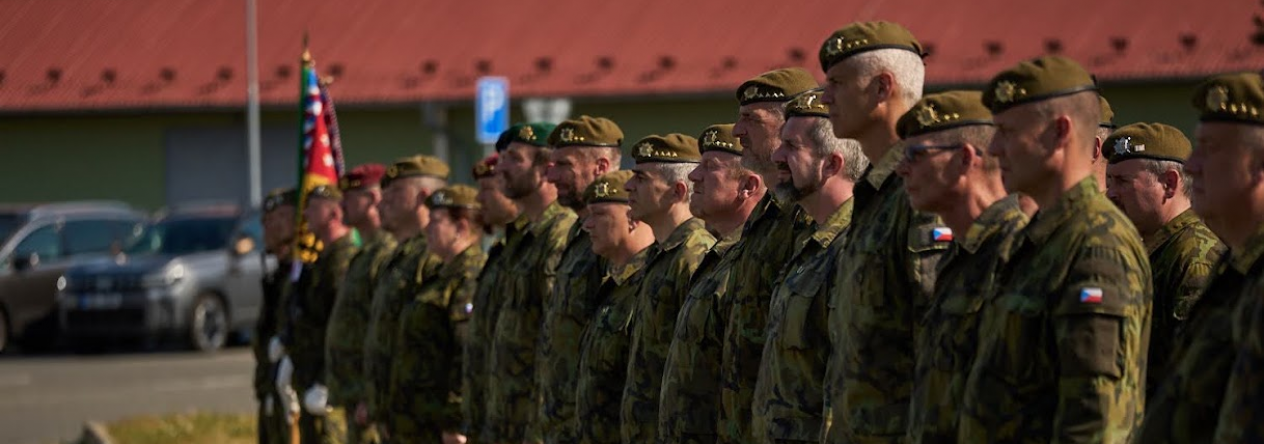
The Czech Republic will assume the role of Framework Nation for the V4 EUBG 2028. This responsibility includes coordinating the preparation of the multinational formation and establishing the conditions necessary for its effective operation.
This does not mean that the Czech Armed Forces can independently decide to deploy troops from other participating nations. Each country retains its national decision-making authority, while any deployment remains subject to the appropriate political and military decisions. The Framework Nation nevertheless carries out a substantial part of the organisational and coordination work essential to the formation's effectiveness.
For the Czech Armed Forces, including the Czech Land Forces, this responsibility offers an opportunity to further develop the capabilities required for multinational operations. Readiness is not limited to individual soldiers and units. It also involves the ability to command more complex military operations, coordinate different specialisations and cooperate with partner armed forces.
Experience gained in establishing and preparing the joint formation will also benefit future international cooperation. The ability to plan and operate alongside European partners is important both for EU operations and for the Czech Republic's commitments within NATO.
European Security and Shared Responsibility
The security environment in and around Europe has changed significantly in recent years. The European Union is therefore developing capabilities that enable it to respond to crises using both civilian and military instruments. Building on the original EU Battlegroup concept, the broader EU Rapid Deployment Capacity enables the assembly of military forces of up to 5,000 personnel.
The EU's Common Security and Defence Policy is rooted in wider objectives, including the promotion of peace, democracy, the rule of law, human rights and respect for international law. Military formations are one of the instruments through which the Union can contribute to security and international crisis management.
The Czech Republic's participation in the V4 EUBG 2028 therefore involves more than providing a certain number of troops. By assuming the leading role, the Czech Armed Forces will contribute to the development of joint European military capabilities and the preparation of forces that may be employed to protect lives, maintain peace and restore stability in crisis-affected regions.
Author: Maj Richard Maňásek

